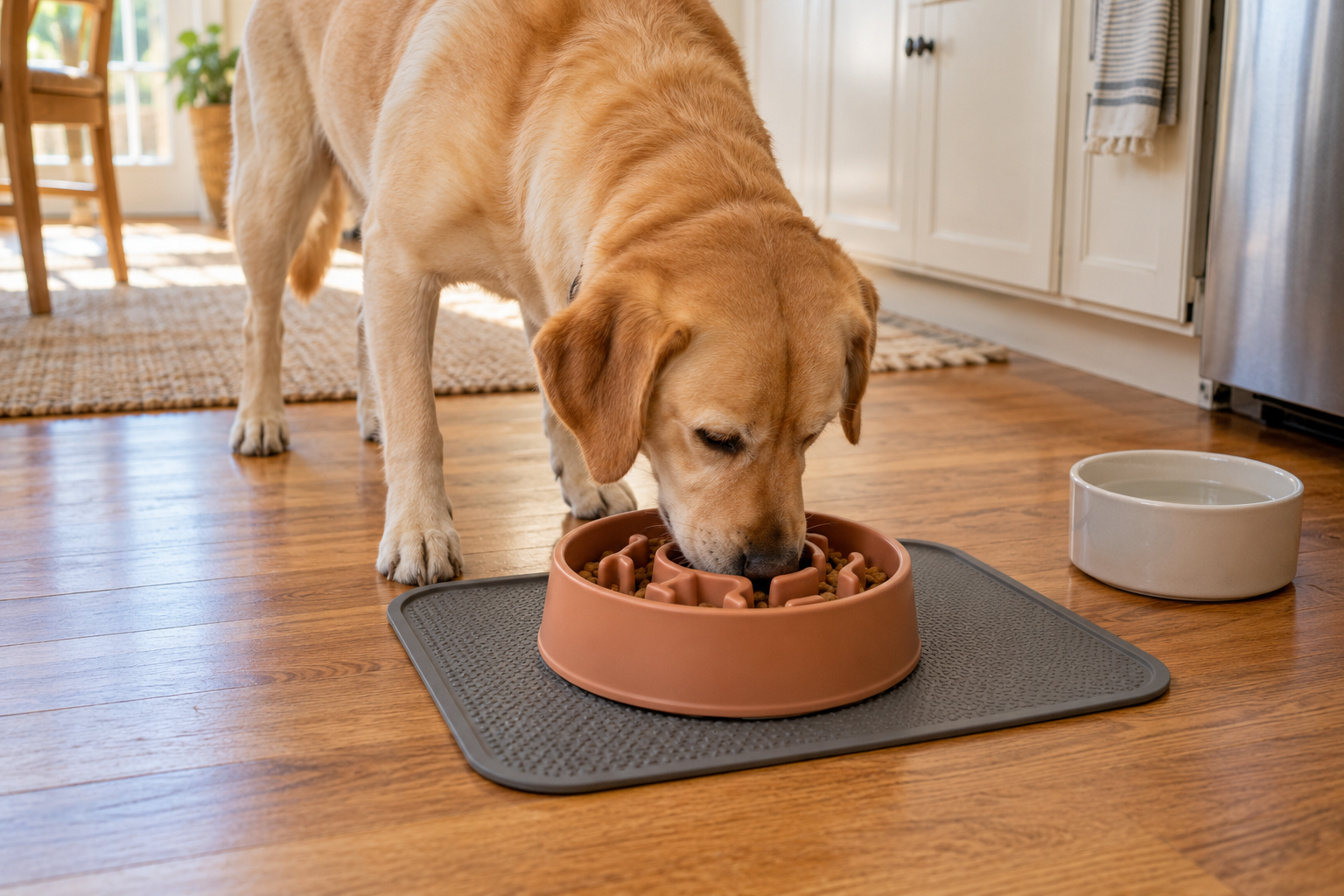
Some dogs treat dinner as a sprint. A well-chosen slow feeder adds small obstacles that turn one mouthful after another into a more deliberate meal. The goal is not to frustrate the dog or promise protection from every digestive problem. It is simply to make gulping harder while keeping the bowl stable, appropriately sized, and easy to wash.
The short version
- Best all-around patterned bowl: Outward Hound Fun Feeder Slo Bowl. Multiple capacities and maze designs make it easier to match the challenge to the dog.
- Best stainless-steel option: Neater Pets Slow Feed Bowl. A straightforward raised-center design is easier to sanitize and less visually complicated than deep plastic mazes.
- Best for soft or mixed food: LickiMat Slomo. Separate textured zones spread food into a thin layer, making it useful for wet food, soaked kibble, and supervised enrichment.
How we chose
We compared materials, capacity, ridge spacing, non-slip features, and cleaning instructions. We looked for products that work with realistic portions and do not rely on medical promises. FieldPaw did not time dogs eating from these bowls. Manufacturer claims about slowing a meal should be treated as design intent, not a guaranteed result for every dog.
Our three picks
Outward Hound Fun Feeder Slo Bowl: best all-around choice
The Fun Feeder line comes in several capacities and ridge patterns. The manufacturer lists versions from roughly three-quarters of a cup through larger bowls holding several cups, with non-slip bases and top-rack dishwasher-safe construction. The bowls are described as free of BPA, PVC, lead, and phthalates.
Best for: kibble eaters who need a more obvious maze and owners who want several size choices. Watch-outs: do not assume the most intricate pattern is best. A flat-faced dog, a puppy, or a dog new to puzzle feeding may do better with wider channels and shallower ridges.
Best all-around patterned bowl
Outward Hound Fun Feeder Slo Bowl
Best for: Kibble eaters that need a visible maze and owners who want several size and pattern choices.
Why it made the guide
- Available in several capacities and ridge patterns.
- Non-slip base helps the bowl stay in place during use.
- Manufacturer lists the bowl as top-rack dishwasher safe.
Pros
- Multiple patterns make it easier to match the challenge to the dog.
- Several capacity choices.
- Straightforward dishwasher cleaning.
Cons
- Deep patterns may frustrate flat-faced dogs, puppies, or first-time users.
- The exact size and pattern must be checked before purchase.
Neater Pets Slow Feed Bowl: best stainless-steel option
Neater Pets uses a stainless-steel bowl with a raised center that pushes food around the perimeter. It is dishwasher safe and offered in multiple sizes. Some versions are designed to fit Neater Feeder stands, while others can be used on their own.
Best for: owners who prefer stainless steel and dogs that need a modest obstacle rather than a deep maze. Watch-outs: a determined dog may learn to sweep food around a single central bump more quickly than it would navigate multiple ridges. Check stand compatibility before assuming it will fit an existing feeder.
LickiMat Slomo: best for wet and mixed meals
The Slomo combines pockets and raised textures in a shallow mat. Soft food can be spread across the surface; kibble can sit in the larger pockets. This creates a different challenge from a conventional bowl and can be useful for dogs that eat canned food or a mix of textures.
Best for: supervised wet-food meals and dogs that prefer licking to navigating tall ridges. Watch-outs: this is not a chew toy. Remove it when the meal is over, and choose another option for a dog that bites or tears flexible feeding mats.
At-a-glance comparison
| Feeder | Material/design | Works best with | Main tradeoff |
|---|---|---|---|
| Outward Hound Fun Feeder | Plastic maze bowl | Dry food | Deep patterns may frustrate some dogs |
| Neater Pets Slow Feed Bowl | Stainless steel, raised center | Dry or simple mixed meals | Less challenging for expert gulpers |
| LickiMat Slomo | Textured feeding mat | Wet, soaked, or mixed food | Requires supervision with chewers |
Choose challenge, not frustration
Start with a pattern that lets the dog reach food without scraping the nose or trapping the tongue. Watch the first several meals. A useful slow feeder produces steady eating; it should not cause frantic pawing, flipping, whining, or chewing. If the bowl is too difficult, switch to wider channels or place part of the meal in a regular bowl while the dog learns.
What a slow feeder cannot promise
Do not treat any bowl as prevention for gastric dilatation-volvulus, commonly called bloat. GDV is a life-threatening emergency with multiple risk factors. A swollen abdomen, repeated unproductive retching, restlessness, weakness, or collapse requires immediate veterinary attention. Ask your veterinarian about meal size, exercise timing, and feeding strategy if your dog is at higher risk.
Cleaning and inspection
Ridges hold saliva and food residue, so clean a slow feeder after every meal. Use a small brush for corners the dishwasher may miss. Replace bowls with deep scratches, sharp edges, peeling surfaces, or loose non-slip pieces. For flexible mats, inspect both sides for tooth marks or tears.
Frequently asked questions
Can a puppy use a slow feeder?
Yes, if the bowl is appropriately sized and the pattern is shallow enough for the puppy’s muzzle. Supervise closely and stop if the puppy starts chewing the bowl.
Will a slow feeder work for a flat-faced dog?
Some will, but deep, narrow channels may be uncomfortable. Look for broad spacing and low ridges, and watch for rubbing around the nose and eyes.
Can I freeze food in a slow feeder?
Only if the manufacturer says the material is freezer safe. Introduce frozen meals gradually, and account for the food in the dog’s normal daily portion.
The bottom line
Choose the Outward Hound for a traditional maze in several sizes, the Neater Pets bowl for simpler stainless-steel cleanup, and the LickiMat for supervised soft-food feeding. The best slow feeder is the easiest one for your dog to use calmly and for you to clean completely.
Continue with the full collection of FieldPaw dog buying guides.