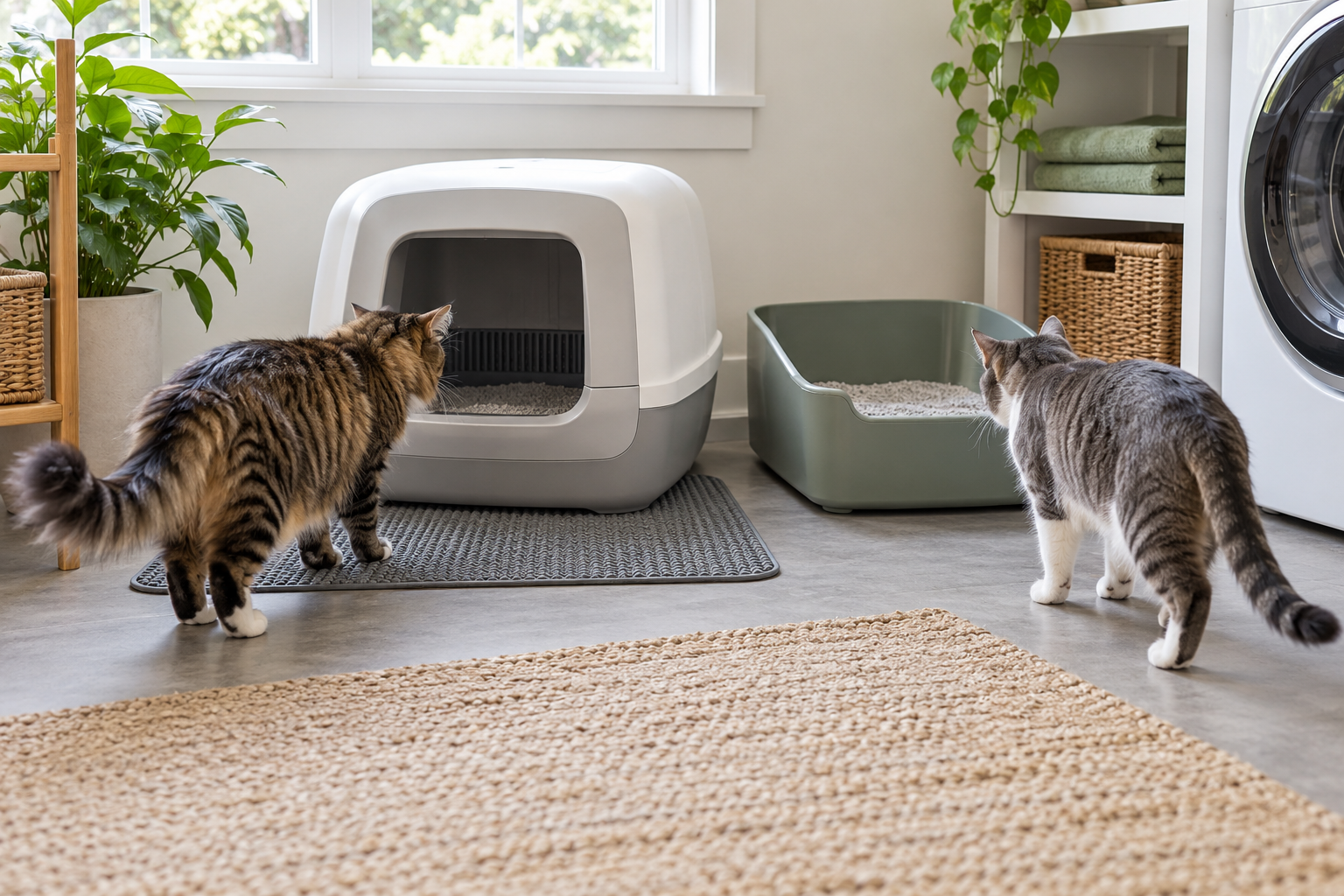
A self-cleaning litter box can reduce daily scooping, but it adds motors, sensors, moving parts, and a new shape that a cat may reject. In a multi-cat home, it also does not erase the need for enough bathroom options. The best unit is one your cats will use reliably, that stops when a cat approaches, and that you can still take apart for a proper wash.
The short version
- Best established premium system: Whisker Litter-Robot 4. Multiple safety sensors, app records, published dimensions, and support for up to four cats make it the best-documented system here.
- Best for a compact rotating-drum approach: PetSafe ScoopFree SmartSpin. It works with clumping litter and adds app-based waste and use tracking.
- Best open-top design: Neakasa M1 Plus. A wide, uncovered entrance can feel less confining to large or cautious cats, while infrared and weight sensors monitor use.
How we chose
We compared entry style, cat-size guidance, sensor systems, litter requirements, waste-bin access, app usefulness, and cleaning steps. We gave extra weight to designs with clear safety documentation and a stable operating history. FieldPaw did not conduct mechanical safety testing. Owners should follow current manufacturer weight and age limits and supervise the transition.
Our three picks
Whisker Litter-Robot 4: best established premium system
The Litter-Robot 4 uses a rotating globe, a sealed waste drawer, laser sensing, weight detection, and anti-obstruction controls. Whisker says one unit can support up to four cats and publishes a footprint of roughly 22 by 27 inches, with a height just under 30 inches. The app tracks visits and drawer status.
Best for: owners who want a well-documented system and are prepared for a large appliance. Watch-outs: the exterior footprint is only part of the fit; allow room for a cat to approach and for you to pull the drawer and clean the globe. Weight data may be harder to assign accurately when two cats are similar in size.
Best established premium system
Whisker Litter-Robot 4
Best for: Owners who want a well-documented automatic litter system and have room for a large appliance.
Why it made the guide
- Uses laser sensing, weight detection, and anti-obstruction controls.
- Sealed waste drawer and rotating-globe cleaning system.
- App reports visits and waste-drawer status.
Pros
- Detailed manufacturer setup and safety documentation.
- Designed to support as many as four cats according to Whisker.
- Tracks visits and drawer status.
Cons
- Large footprint and substantial purchase commitment.
- Weight data can be harder to assign when cats are similar in size.
PetSafe ScoopFree SmartSpin: best compact drum alternative
The SmartSpin sifts clumping litter through a rotating chamber and deposits waste in a drawer. PetSafe advertises app tracking for litter level, waste-drawer status, and cat use, along with odor-control features. Unlike older ScoopFree tray systems, this model uses compatible clumping litter.
Best for: owners who want a mainstream brand and do not want a proprietary crystal tray. Watch-outs: confirm the current cat-weight guidance and exact litter specification before setup. Curved interior space may feel smaller than the outside dimensions suggest.
Neakasa M1 Plus: best open-top design
The M1 Plus keeps the top open rather than asking a cat to enter a round doorway. Neakasa lists six pairs of infrared sensors and four weight sensors, with operation designed to stop when a cat enters or touches the unit. The app reports use and waste status.
Best for: larger cats and cats that dislike enclosed boxes. Watch-outs: an open top can allow more litter scatter, and higher sides still require a comfortable step. App data should never be treated as proof that a cat is healthy.
At-a-glance comparison
| Box | Entry | Monitoring | Main tradeoff |
|---|---|---|---|
| Litter-Robot 4 | Front opening into globe | Weight, visits, drawer status | Large appliance and premium commitment |
| PetSafe SmartSpin | Front opening into drum | Use, litter, and waste status | Interior and litter compatibility need checking |
| Neakasa M1 Plus | Open top | Weight, use, and waste status | More potential scatter |
The multi-cat rule still applies
The ASPCA recommends one litter box per cat plus one extra, placed in different locations. A machine that cleans after each visit may stay fresher, but it remains a single location that one cat can guard. Keep at least one conventional box during the transition and longer if any cat hesitates, blocks another cat, or eliminates elsewhere.
A safer transition
- Set the new unit beside a familiar box and leave automatic cycling off.
- Add a small amount of used litter so the new box smells familiar.
- Let each cat investigate for several days without motion.
- Run a manual cycle only while the cats are elsewhere, then reward calm behavior nearby.
- Enable automatic operation only after all cats use the box confidently and meet the maker’s minimum weight and age guidance.
Avoid unverified machines with poorly documented openings, pinch points, or safety sensors. Inspect the unit routinely and stop automatic operation if a sensor is dirty, damaged, or behaving unpredictably.
Frequently asked questions
Can a kitten use a self-cleaning litter box?
Only according to the manufacturer’s current minimum weight and operating instructions. Small kittens may not trigger weight sensors reliably. Use manual or powered-off mode and a conventional box until the kitten is eligible.
Does self-cleaning mean I never scoop or wash?
No. You still empty the waste drawer, top up litter, wipe sensors, remove stuck waste, and periodically wash approved parts. The machine reduces one chore; it does not eliminate sanitation.
What if my cat urinates outside the new box?
Restore an accessible conventional box immediately and consult a veterinarian to rule out a medical problem. Do not punish the cat or force it into the machine.
The bottom line
The Litter-Robot 4 has the deepest support documentation, the SmartSpin pairs a familiar brand with ordinary clumping litter, and the Neakasa’s open top may be easier for a large or enclosure-shy cat. Keep extra boxes, respect every cat’s response, and treat sensors as a backup to supervision–not a replacement for it.
Continue with the full collection of FieldPaw cat buying guides.